
- Science news
- Institutional partnerships
- Frontiers institutional partnerships update – summer 2026
Frontiers institutional partnerships update – summer 2026

Open access on your terms: flexible, transparent, built for the future
Everything we do with institutions starts from the same commitment: immediate, open access to the published research, on terms that work for your budget and your researchers. We know libraries are working within real constraints – decentralized funding, open access budgets that struggle to keep pace with demand, and subscription spend. So we design agreements around those realities: a spectrum of payment options, from lower-commitment author discounts and pay-as-you-go to unlimited publishing, all flexible, transparent, and with minimal long-term commitment required.
The momentum is clear. In the first half of 2026, we welcomed 30 new institutional partners and renewed or expanded agreements with more than 200 institutions worldwide, building on a global network of over 740 institutional and consortia agreements. Each was shaped around the partner’s goals – with clear, predictable terms and cost-sharing options that let libraries and funders expand coverage without expanding budgets. Behind every agreement is the same offer to your researchers: rigorous quality, backed by one of the largest research-integrity teams in the industry and our award-winning AIRA technology; and reach, through CC-BY licensing, global indexing, and a researcher-led model of field journals, specialty sections, and Research Topics. This update covers what’s new since the start of the year – and two developments we’re especially excited to share: FAIR² Data Management and our institutional portal.
New partnership announcements
Over the past six months we’ve signed new agreements and expanded existing ones with a diverse group of partners across Europe and North America. We’re grateful for their trust in our shared mission.
New partners
Princeton University, USA
Georgetown University Medical Center, USA
University of Notre Dame, USA
University of Essex, UK
Deutsches Elektronen-Synchrotron (DESY), Germany
TH Köln, Germany
Medical School Berlin and MSH Medical School Hamburg, Germany
University of Erfurt and Hochschule Furtwangen, Germany
University of Graz, Austria
INVALSI – National Institute for the Evaluation of the Education System, Italy
University of Ljubljana – Faculties of Sport, Veterinary Medicine, and Biotechnology, Slovenia
Renewed and expanded partnerships
Delft University of Technology (TU Delft), Netherlands
University of Nottingham and Cranfield University, UK
University of Kansas, USA
Oslo New University College, Norway
University of Mannheim and University of Potsdam, Germany
Martin Luther University of Halle-Wittenberg, Germany
TIB – Leibniz Information Centre for Science and Technology, Germany
ZHAW Zurich University of Applied Sciences, Switzerland
National consortia:
Sikt (Norway) – renewal of the national open access agreement for 2026, first signed in 2020, continuing seamless publishing for researchers across Norwegian institutions.
Bibsam Consortium (Sweden) – renewed for 2026, sustaining open access publishing across the Swedish universities, university colleges, and government agencies in the consortium.
Consortium of Swiss Academic Libraries – renewed for 2026, supporting affiliated authors across participating Swiss institutions, now including University of Applied Sciences Northwestern Switzerland (FHNW) and PH Koordinationsstelle Konsortium/HEP Bureau de coordination Consortium. The consortium is comprised of nine institutions:
St. Gallen University of Teacher Education
Swiss Federal Institute for Vocational Education and Training (SFUVET)
Thurgau University of Teacher Education
University of Teacher Education BEJUNE
University of Teacher Education in Special Needs
University of Teacher Education NMS Bern
University of Teacher Education of Schaffhausen
University of Teacher Education of the Grisons
University of Teacher Education of Valais
CONNECTK (Slovenia) – a renewed national consortium agreement from April 2026, bringing Slovenian institutions, including faculties of the University of Ljubljana, into central open access coverage for the first time.
Agreements like these are built collaboratively with libraries, consortia, and university administrations, and often include shared goals around monitoring usage, reducing barriers for authors, and supporting disciplinary equity in publishing.
New: FAIR² Data Management for your researchers’ data
Fewer than 10% of research datasets are ever shared or reused – the rest stay locked in labs, invisible to science. At the same time, every major funder now expects FAIR-aligned data management, and 'data available upon request' no longer satisfies an audit. FAIR² Data Management, helps your institution close that gap.
It’s a simple, AI-assisted workflow – upload, curate, publish. Researchers upload a dataset in any format; an AI data steward validates, enriches, and structures it for FAIR² compliance; and the result is a peer-reviewed Data Article with its own DOI plus an interactive data portal – turning weeks of preparation into hours.
What it means for your institution
A data-management cost, not a publishing cost – it fits the data management plan (DMP) budget line that funders already require in every grant, and that is often allocated but underused.
Offloads your RDM workload – the AI handles the curation, structuring, and metadata work your team can’t keep up with.
A citation multiplier – papers linked to archived data receive up to 25% more citations, and each Data Article is a new citable publication in its own right (Colavizza et al., PLOS ONE 2020).
Replaces 'data available upon request' – with a certified, permanent, auditable record that stands up to funder scrutiny.
FAIR² is sold separately from publishing agreements and is available to institutions now. If you’d like a walkthrough or a live demo for your data-management team, just let us know.
Events news
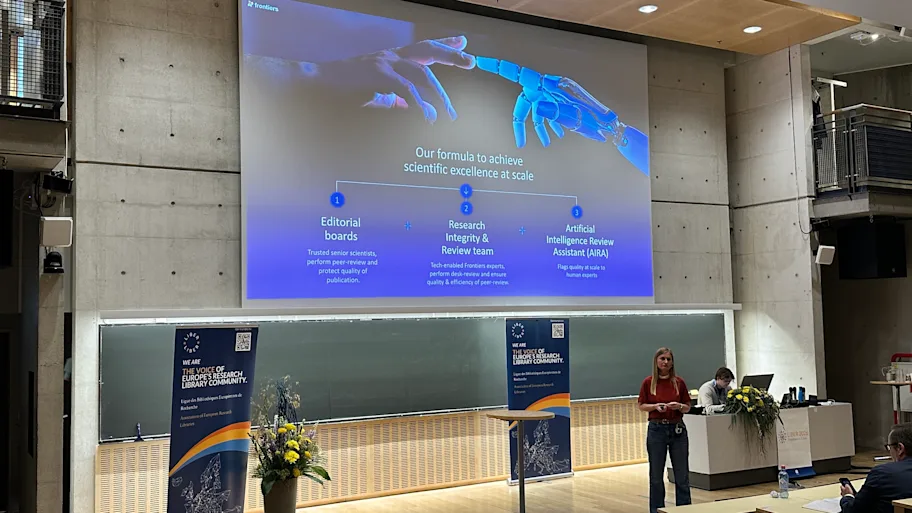
The highlight of our first half was LIBER 2026, the 55th LIBER Annual Conference, hosted by NTNU University Library in Trondheim, Norway, from 1 to 3 July under the theme ‘The Power of Libraries in an Uncertain World.’ LIBER is Europe’s largest association of research libraries, representing 420+ university, national, and research libraries, and this year we joined as a Gold Sponsor.
Frontiers’ CEO Dr Kamila Markram delivered a plenary session on how publishers and libraries can build a more transparent, reliable, and scalable knowledge system together, and our team held strategic conversations throughout the event with individual libraries, national delegations, and consortia. Discussions centered on:
AI-driven integrity and how Frontiers uses technology to strengthen human oversight in peer review
FAIR² framework and the practical pathways for institutions to meet evolving data-sharing mandates
evolving role of the library in an era of machine-readability and AI-readiness
how to convert institutional research output into real world tangible solutions for a healthy planet
It was a valuable chance to hear directly from library leaders about the challenges they’re navigating and to talk through the flexible models we’ve built in response.
Where you’ll find us next: we will continue to take part in the major library and open science events through the second half of the year. If you would like to arrange a meeting with our partnerships team at an upcoming conference, just get in touch.
Looking ahead
For the rest of 2026 we are focused on giving partners more control and more clarity: greater flexibility in how agreements are structured, richer and more transparent usage data through the insights portal, tighter integrations with library systems, and the responsible use of AI – across editorial, peer review, and data management – that supports your teams without adding burden. If you are exploring flexible funding models in your region, or collaborative approaches to funding open publishing, we are happy to share materials, case studies, or connect you with peers doing similar work.
Catch up on other news from Frontiers
Could your institution partner with Frontiers?
Hundreds of institutions around the world already partner with Frontiers. Institutional representatives can reach out to us at institutions@frontiersin.org or via our online form for more information.
Other collaborations at Frontiers
Frontiers Science House, launched on the Davos Promenade during the World Economic Forum Annual Meeting in January 2026, is a standing venue connecting breakthrough science to government, business, investors, and philanthropists, backed by more than 30 global partners including a growing group of universities and research institutes. It runs sessions and summits year-round, and there’s room for your institution to get involved – whether that’s co-hosting a session or putting your researchers in front of policymakers and funders. If you’d like to explore a Frontiers Science House collaboration, let us know and we’ll connect you with the team.