- Science news
- Featured news
- Playing lemurs and a ‘koala brain atlas’: Here are Frontiers’ photo highlights of the month
Playing lemurs and a ‘koala brain atlas’: Here are Frontiers’ photo highlights of the month
At Frontiers, we bring some of the world’s best research to a global audience. But with tens of thousands of articles published each year, it’s impossible to see all that research in the same way scientists do. Here are some images that showcase some of the newest findings published in the last month.
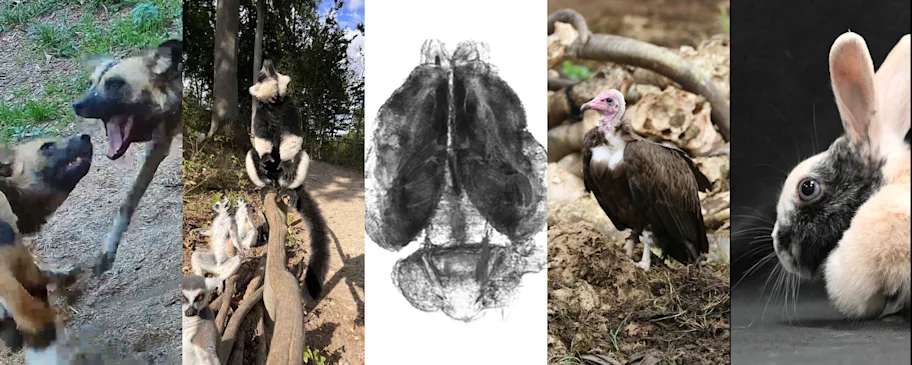
Lemurs of different species playing together could help us understand evolution of social play
Researchers in Germany and Austria observed inter-species play behavior of adult black-and-white ruffed lemurs and juvenile ring-tailed lemurs and found multiple behaviors consistent with play from both species. The results were published in Frontiers in Ecology and Evolution. These are thought to be the first observations of interspecific play – a behavior rarely described in primates – between these two species.
Video: Interspecific play behavior between multiple ring-tailed lemurs and a black-and-white ruffed lemur at Affenwald Wildlife Park, Germany. Credit: Lily Broos.
Full article: https://www.frontiersin.org/journals/ecology-and-evolution/articles/10.3389/fevo.2026.1771741/full
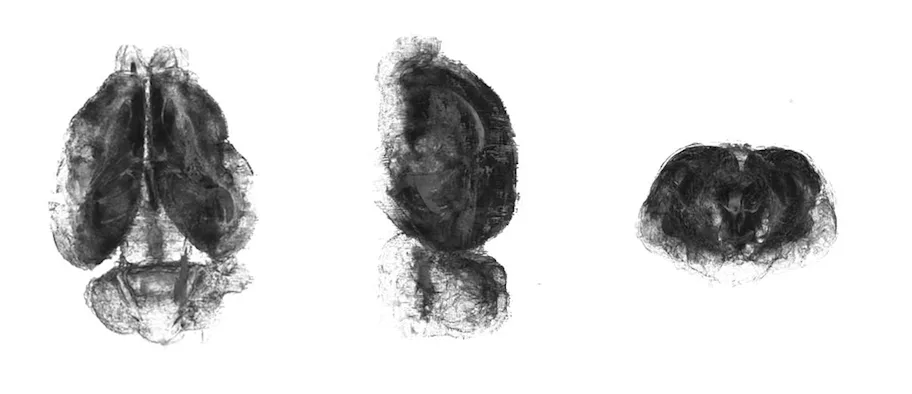
Researchers create ‘koala brain atlas’ using MRI images
Writing in Frontiers in Neurology, a team from The University of Sydney, Western Sydney University, and The University of Queensland used MRI images to provide a detailed description of the shape and size of the brain of an adult female koala. They found that the koala’s brain had a volume of 15.7 cm³ and that the olfactory bulbs made up around 2.7% of the total brain volume.
Full article: https://www.frontiersin.org/journals/neurology/articles/10.3389/fneur.2026.1733030/full
Bunnies sense stranger danger – and it shows
Researchers in the Czech Republic examined stress responses of domestic rabbits by measuring salivary corticosterone and observing behavioral responses to stroking sessions delivered by an unfamiliar person. They found a significant increase in corticosterone concentrations – a hormone directly related to stress – and behavioral changes, including tense postures, ears pressed against their bodies, and closed eyes, which significantly correlated with increased stress hormone levels. The results were published in Frontiers in Veterinary Science.

Full article: https://www.frontiersin.org/journals/veterinary-science/articles/10.3389/fvets.2026.1793812/full
Can carnivores communicate across species?
In a new Frontiers in Ethology study, researchers in the US observed the interspecies gestural communication of three social carnivore species – spotted hyenas, African wild dogs, and Mexican gray wolves – housed in different zoos. The team’s aim was to provide a unified coding framework that facilitates cross-species comparisons of gesture form and function, including that of shared interspecific gestures. They identified gestures unique to single species as well as a small core of overlapping gestures.
Video: Filmed are Taz (male, 23) and Grungy (female, 15), a dyad of spotted hyenashoused at the Buffalo Zoo. Grungy can be seen approaching Taz, who subsequently emits a ‘relaxed open mouth’ (ROM) towards him. ROM is a manual gesture used as an anticipatory signal, primarily during playful interactions, to convey to the play partner that the sender’s subsequent actions are intended solely for play. ROM is observed in the repertoires of many species, though it has previously been described in research using species-specific ethograms. Credit: Andrew Laurita.
Full article: https://www.frontiersin.org/journals/ethology/articles/10.3389/fetho.2026.1770290/full
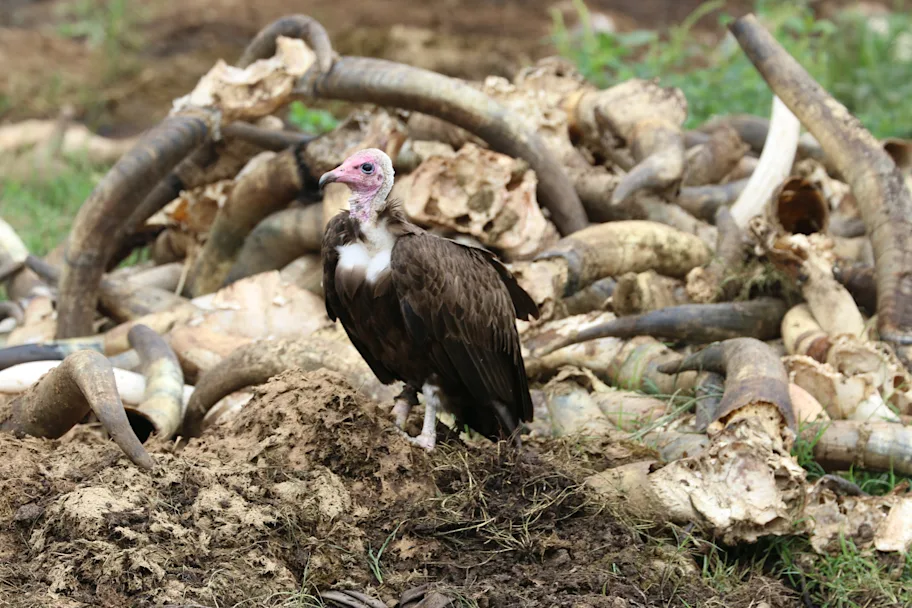
Critically endangered vultures in Africa found in less than half of monitoring sites
Vultures remove animal carcasses and reduce the risk of disease spreading from dead animals to humans. Especially in regions with limited waste management, this service is invaluable. However, several species of vultures are disappearing due to human activity. A new Frontiers in Bird Science study done inChad found that hooded vultures were present at just five out of 11 monitored sites, despite an abundance of food and a long history of co-existence with humans in the region. One reason could be illegal wildlife trade, reported by over a third of interview respondents consulted in the study.
Full article: https://www.frontiersin.org/journals/bird-science/articles/10.3389/fbirs.2026.1726840/full
REPUBLISHING GUIDELINES: Open access and sharing research is part of Frontiers’ mission. Unless otherwise noted, you can republish articles posted in the Frontiers news site—as long as you include a link back to the original research. Selling the articles is not allowed.